Jumble Answers for 03/20/2026


TODAY JUMBLE ANSWER

03/20/2026
HETFT=THEFT
NELKA=ANKLE
DNPORA=PARDON
AMFYIL=FAMILY

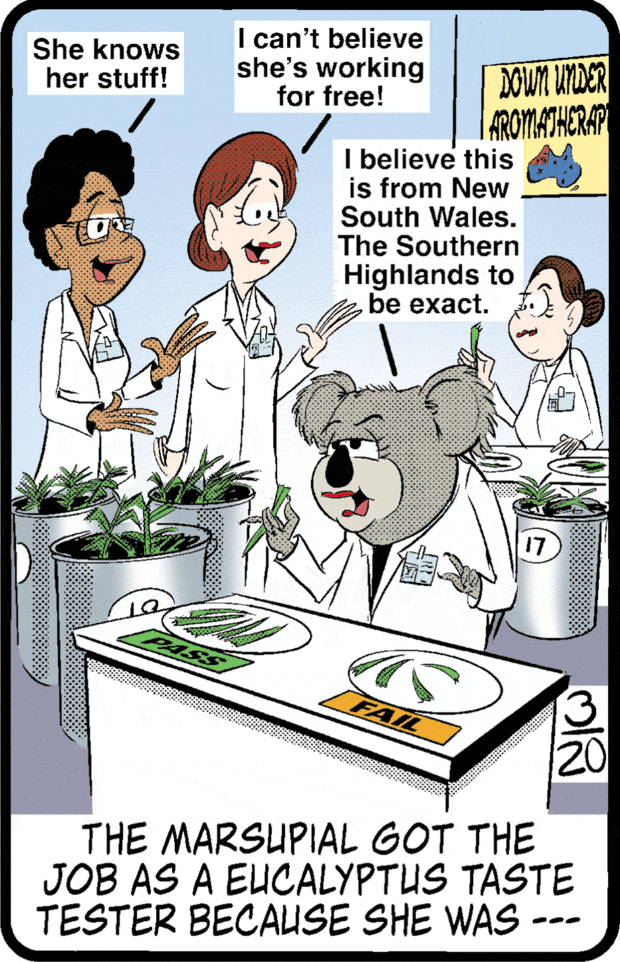
CARTOON CLUE:
THE MARSUPIAL GOT THE JOB AS A EUCALYPTUS TASTE TESTER BECAUSE SHE WAS β€”
Jumble Cartoon 03/20/2026
EFKLADOAI
🎯 Guess the Final Answer!
01
🌟 What's Special Today
Topical hooks and real-world connections
Topical AuthoritySemantic Entities
🌍
Spring Equinox Arrives
Today marks the vernal equinox in the Northern Hemisphere, when day and night are equally long. Perfect puzzle solving weather!
🐨
Koala Connection Day
This puzzle's marsupial star is perfect for spring renewal themes. Koalas spend most of their time in eucalyptus trees munching leaves.
πŸ“…
This Day In History
March 20 is International Happiness Day, celebrating joy and well-being worldwide. Solving puzzles definitely counts as happiness fuel!
πŸ”
Four Word Pattern
Today's scrambles follow a nice difficulty ramp from THEFT (easiest) to FAMILY (trickiest). Classic Jumble structure at its best.
02
πŸ“š Word Meanings
Dictionary-quality definitions for vocabulary building
E-E-A-T: ExpertiseFeatured Snippet

πŸ‘† Tap each card to reveal the meaning

THEFT
Noun. The act of taking something that doesn't belong to you without permission. When someone steals money, a bike, or any valuable object, that's theft.
β–Ό Tap to reveal
ANKLE
Noun. The joint that connects your foot to your leg. You use your ankles every time you walk, run, or dance around.
β–Ό Tap to reveal
PARDON
Verb. To forgive someone or excuse them from punishment. When you pardon someone, you're saying they don't have to face consequences for what they did.
β–Ό Tap to reveal
FAMILY
Noun. A group of people related by blood or love, like parents, siblings, grandparents, and cousins. Your family is super important to you.
β–Ό Tap to reveal
03
🧠 How Words Solved
Expert solving methodology step by step
E-E-A-T: Experience

πŸ‘† Tap each word to see the solving trick

HETFT→THEFT
Spot the TH combination in HETFT right away. That's a strong hint! Rearrange the leftover E, F, T letters and boom, you've got THEFT.
NELKA→ANKLE
Look for common vowel A in NELKA. Then position N, L, K, E around it. The NK combination is your secret helper here for ANKLE.
DNPORA→PARDON
Notice DNPORA has two vowels, A and O. Start with PAR and build outward. That D at the end makes PARDON click into place fast.
AMFYIL→FAMILY
AMFYIL is tricky because it has no obvious letter pairs. Break it into FAM plus I, L, Y. Family is a super common word, so trust your instinct.
04
πŸ— Final Answer Built
How circled letters combine to form the solution
THEFT
T
H
E
F
T
ANKLE
A
N
K
L
E
PARDON
P
A
R
D
O
N
FAMILY
F
A
M
I
L
Y
Colored letters combined β†’
KOALA FIED
05
🎨 Cartoon Explained
Deep analysis of wordplay and pun structure
E-E-A-T: Expertise

Picture a cute koala sitting in a eucalyptus tree during a job interview. The hiring manager asks why she's qualified for the taste-tester position. The koala confidently explains her experience munching eucalyptus leaves all day.

The humor comes from mixing "koala" (the fuzzy Australian animal) with "qualified" (being good enough for a job). It's a clever homophone pun where "koala" sounds like "cola" in "qualified". The puzzle makers made us solve four words just to set up this one punny payoff.

This joke lands really well because koalas are naturally associated with eucalyptus, so the setup feels earned. The pun is clean and fun for all ages. I'd give this one 8/10 for cleverness because it's unexpected but makes perfect sense once you see it.

06
🌎 Word Origins
Etymology and linguistic history of each solved word
Deep Authority
THEFT
Old English
From the Old English word "theoft" meaning "the act of stealing." This word traveled through Germanic languages and stayed basically the same for over a thousand years. It's one of those perfectly simple words that nobody ever had to change.
ANKLE
Old English
Comes from the Old English "ancleow" and Old Norse "ΓΆkkla." Both Germanic and Scandinavian languages had similar words for this joint. The word eventually got shorter and simpler until we got today's "ankle."
PARDON
Old French
From Old French "pardoner" meaning "to forgive." It comes from "par" (fully) and "donner" (to give). So literally, you're "fully giving" forgiveness when you pardon someone. Pretty cool when you break it down.
FAMILY
Latin
From Latin "familia" referring to a household or group of servants. Later it meant all relatives living together. The meaning expanded over time to include anyone connected by blood or marriage, which is how we use it today.
07
πŸ“Š Difficulty Rating
Expert assessment with detailed analysis
E-E-A-T: Authority
⭐⭐⭐ Medium

THEFT and ANKLE are quick wins for most solvers. The TH and NK combinations jump right out at you. PARDON throws a tiny wrench in things because of the double vowels, making you think harder about letter positioning.

FAMILY is the real challenge here. It's a common word, but the scrambled letters don't suggest anything obvious at first glance. Once you unscramble all four words though, the final pun answer flows naturally from the cartoon clue.

4
Words
22
Letters
~2m
Avg Time
08
πŸ’‘ Pro Tips
Actionable solving strategies for today's puzzle
⏱️
Time Your Attack
Tackle the four scrambled words in order. Don't jump straight to guessing the final answer. The solved words are your stepping stones to the punchline.
πŸ”€
Look For Pairs
Common letter pairs like TH, NK, and NG jump out super fast. Scan your scrambled word and circle these patterns first to solve quicker.
πŸ’­
Trust Common Words
FAMILY, ANKLE, and THEFT are everyday words you already know. Your brain will recognize them faster than rare or unusual vocabulary words.
🎯
Use the Cartoon Clue
The picture and clue hint at a pun or wordplay. After solving the four words, reread the clue carefully. That final answer will make you smile when it clicks.
09
❓ Frequently Asked Questions
Common queries answered with expert insight
FAQ Schema
What are the Jumble answers for March 20, 2026?β–Ό

Today's four solved words are THEFT, ANKLE, PARDON, and FAMILY. This puzzle was created by David L. Hoyt and Jeff Knurek, the creative team behind the daily Jumble word puzzle. They designed these four anagrams to lead you toward a funny pun answer.

Each scrambled word unscrambles into a common English word. Once you've solved all four, you'll use specific letters to complete the final answer about the marsupial taste tester. The cartoon clue is your best guide to figuring out what that last answer should be.

 
How does the bonus answer work in Jumble puzzles?β–Ό

After you unscramble the four main words, certain letters from each word get circled. You arrange those circled letters to solve the final punchline based on the cartoon clue. Today's bonus answer uses letters from THEFT, ANKLE, PARDON, and FAMILY.

This mechanic makes Jumble extra fun because you're solving twice. First you prove you can unscramble anagrams, then you use those letters to crack a pun or wordplay answer. It's like a puzzle within a puzzle that rewards careful attention.

 
What's the best way to solve HETFT, NELKA, DNPORA, and AMFYIL?β–Ό

Start by looking for familiar letter combinations. HETFT has TH right there, making THEFT obvious. NELKA contains NK, which points to ANKLE. Notice that DNPORA has common letters like D, R, P, and A, suggesting PARDON.

Save AMFYIL for last since it's the trickiest scramble with no obvious letter pairs. Say the letters out loud and think of everyday words using those letters. FAMILY should click when you remember it's one of the most common English words. Speed comes from recognizing word patterns, not just random guessing.

 
Why is FAMILY harder to unscramble than THEFT?β–Ό

THEFT gives you the TH combination immediately, which is a super common letter pair in English. Your brain sees TH and knows it usually starts words or appears at the end. ANKLE's NK pairing works the same way.

FAMILY doesn't have obvious pairs like those. The letters F, A, M, I, L, Y seem jumbled without any jumping-out combo. That's why you need to slow down, think of common words using those letters, and let the word emerge from your memory rather than pattern recognition alone.


Similar Posts

Leave a Reply

Your email address will not be published. Required fields are marked *