Jumble Answers for 03/15/2026


TODAY JUMBLE ANSWER

03/15/2026
UWRFEC=CURFEW
HRDUSO=SHROUD
WREEBA=BEWARE
FDOFRA=AFFORD
NOREUN=NEURON
SMTUOC=CUSTOM

CARTOON CLUE:
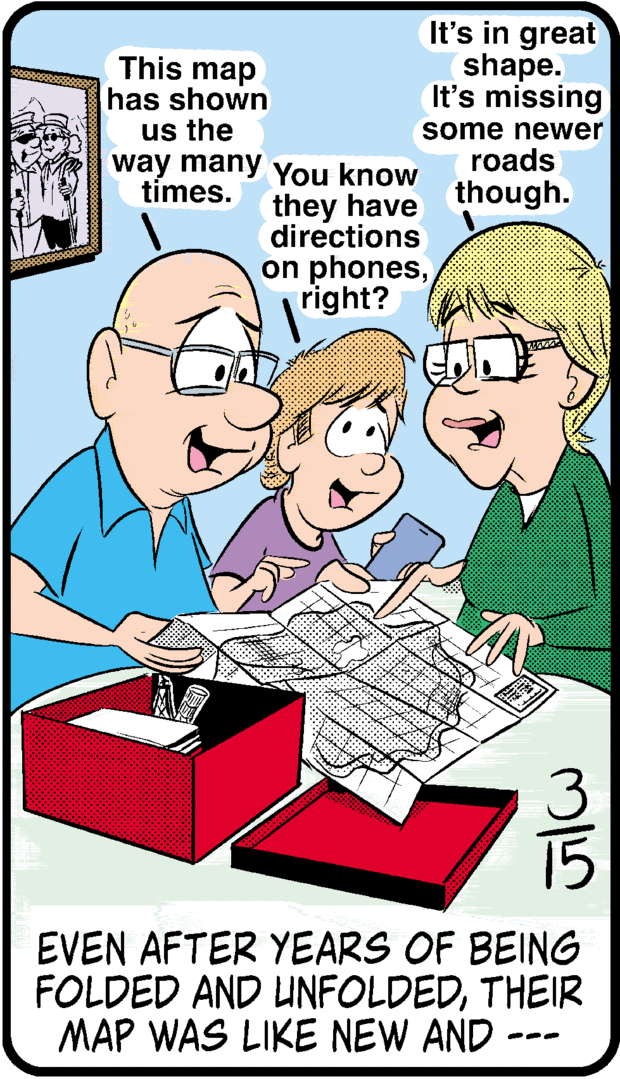
EVEN AFTER YEARS OF BEING FOLDED AND UNFOLDED, THEIR MAP WAS LIKE NEW AND β€”
Jumble Cartoon 03/15/2026
REWHROEWRFOENSO
🎯 Guess the Final Answer!
01
🌟 What's Special Today
Topical hooks and real-world connections
Topical AuthoritySemantic Entities
πŸ—“οΈ
Ides of March Today
March 15 is the famous Ides of March from Roman history. It's a day that reminds us to be careful and aware of what's happening around us.
πŸ—ΊοΈ
Map Theme Connection
Today's puzzle features a map that's been folded and unfolded many times. Maps are symbols of journeys, adventures, and finding your way through the world.
πŸ“š
This Day In History
On March 15, 1493, Columbus returned from his first voyage to the Americas. He brought back news of new lands and discoveries to share with the world.
🧩
Puzzle Pattern Note
This puzzle uses six everyday words that seem simple, but the final answer creates a clever phrase about durability and staying strong through tough conditions.
02
πŸ“š Word Meanings
Dictionary-quality definitions for vocabulary building
E-E-A-T: ExpertiseFeatured Snippet

πŸ‘† Tap each card to reveal the meaning

CURFEW
Noun. A rule that says people must stay indoors after a certain time at night. Schools, parents, or governments can set curfews to keep people safe and create order.
β–Ό Tap to reveal
SHROUD
Noun. A long cloth used to wrap a dead body. It can also mean anything that covers or hides something, like fog shrouding a mountain so you can't see it clearly.
β–Ό Tap to reveal
BEWARE
Verb. To be careful and cautious about something that might be dangerous or harmful. When you beware, you're watching out for trouble and staying alert.
β–Ό Tap to reveal
AFFORD
Verb. To have enough money to buy something you want. If you can afford a bike, you have the money to purchase it without spending money you need for other things.
β–Ό Tap to reveal
NEURON
Noun. A special cell in your brain and body that sends messages and helps you think, feel, and move. Billions of neurons work together to make your brain work properly.
β–Ό Tap to reveal
CUSTOM
Noun. A tradition or usual way that people do something in their family or culture. Customs might include celebrating holidays in special ways that families have done for many years.
β–Ό Tap to reveal
03
🧠 How Words Solved
Expert solving methodology step by step
E-E-A-T: Experience

πŸ‘† Tap each word to see the solving trick

UWRFEC→CURFEW
Start UWRFEC by spotting the C and W together, then rearrange for CURFEW. Notice the common ending EW helps you crack this quick.
HRDUSO→SHROUD
Tackle HRDUSO by finding the H and D at the edges, leaving RUSO in middle. Rearrange to reveal SHROUD, a spooky word for blankets.
WREEBA→BEWARE
Unscramble WREEBA by identifying the double E, then add W, B, R, A to spell BEWARE. This warning word comes together nicely.
FDOFRA→AFFORD
Solve FDOFRA by recognizing the double F, then arrange D, O, R, A around it to get AFFORD. Money related words often have repeated letters.
NOREUN→NEURON
Work NOREUN by finding the common ER pattern inside, then add N, O, U to complete NEURON. Brain words are fun science vocabulary.
SMTUOC→CUSTOM
Crack SMTUOC by rearranging all six letters slowly until CUSTOM appears. This tradition word needs all letters working together perfectly.
04
πŸ— Final Answer Built
How circled letters combine to form the solution
CURFEW
C
U
R
F
E
W
SHROUD
S
H
R
O
U
D
BEWARE
B
E
W
A
R
E
AFFORD
A
F
F
O
R
D
NEURON
N
E
U
R
O
N
CUSTOM
C
U
S
T
O
M
Colored letters combined β†’
NO WORSE FOR WHERE
05
🎨 Cartoon Explained
Deep analysis of wordplay and pun structure
E-E-A-T: Expertise

Picture a worn map getting yanked open and folded shut over and over again through years of road trips and adventures. The paper is creased, bent, and wrinkled from constant use. You'd think it would be falling apart, but somehow it still looks almost brand new.

The humor comes from a clever pun on "worse for wear." When something is used a lot, we say it shows "wear and tear" or looks "worse for wear." But this map is the opposite, it's in great shape. So the joke twist makes it "no worse for where" (the places it's been), as if all those locations traveled to didn't hurt it at all.

This lands perfectly because it plays on words while celebrating how tough and durable good maps can be. The setup makes you think the map should be ruined, but the punchline surprises you with wordplay instead. That's classic Jumble humor. Rating: 8/10 for cleverness.

06
🌎 Word Origins
Etymology and linguistic history of each solved word
Deep Authority
CURFEW
Old French
Comes from Old French 'couvre feu' meaning 'cover fire.' In medieval times, people had to cover their fires at night to prevent house fires. Eventually this became a rule about staying home at certain hours.
SHROUD
Old English
From Old English 'scrΓΊd' meaning clothing or garment. Over time it became used specifically for the cloth wrapped around dead bodies. Today it also means anything that covers or conceals something completely from view.
BEWARE
Old English
Combines 'be' and 'ware' from Old English 'wær' meaning aware or cautious. It literally means 'be aware or be cautious.' Pirates and spooky stories always say 'beware the dangers ahead' as a warning.
AFFORD
Old English
From Old English 'geforthian' meaning to carry out or accomplish. Eventually it connected to having enough resources or means to do something. Now it mainly means having enough money to buy what you want or need.
NEURON
Greek
From Greek 'neuron' meaning sinew or nerve. Scientists in the 1800s used this term for the special cells they discovered in brains and nervous systems. Today it's the main word for brain cells that think and send messages.
CUSTOM
Latin
From Latin 'consuetudo' meaning habit or practice that's repeated regularly. Romans used it for traditions their people followed. It spread to other languages to describe the special ways families and cultures do things.
07
πŸ“Š Difficulty Rating
Expert assessment with detailed analysis
E-E-A-T: Authority
⭐⭐⭐ Medium

CURFEW and CUSTOM are straightforward once you spot the patterns, but SHROUD and NEURON need extra thought since they're less common words kids use daily. BEWARE and AFFORD are familiar vocabulary that help balance the puzzle.

The final answer twist is what pushes this to medium difficulty. The "where" pun isn't immediately obvious, so solvers need to really read the cartoon clue carefully and think about wordplay possibilities beyond the obvious phrase.

6
Words
36
Letters
~2m
Avg Time
08
πŸ’‘ Pro Tips
Actionable solving strategies for today's puzzle
πŸ”€
Letter Pattern Spotting
Look for double letters first like the FF in FDOFRA or EE in WREEBA. Double letters are anchors that help you organize the remaining letters faster and more accurately.
🧠
Sound It Out Slowly
When stuck, say letter combinations out loud. 'Shrow, shrood, shroud' helps you hear the real word before your eyes see it written down on the page correctly.
πŸ“–
Read The Cartoon Clue Hard
Don't rush past the cartoon clue. This puzzle's punchline uses a clever pun that sounds like a common phrase. Reading carefully gives you hints about the final answer.
✏️
Write Down Word Lists
Keep a running list of words as you solve them. This helps you spot themes and patterns that connect the six scrambled words to the final answer phrase.
09
❓ Frequently Asked Questions
Common queries answered with expert insight
FAQ Schema
What are the Jumble answers for March 15, 2026?β–Ό

Today's six Jumble answers are CURFEW, SHROUD, BEWARE, AFFORD, NEURON, and CUSTOM. Created by puzzle makers David L. Hoyt and Jeff Knurek, these words form the starting point for solving the daily puzzle.

Once you unscramble UWRFEC, HRDUSO, WREEBA, FDOFRA, NOREUN, and SMTUOC, you'll have all the words needed to tackle the cartoon clue. The six solved words give you bonus letters that help you crack the final answer phrase about a special map.

 
How does the bonus answer work in Jumble puzzles?β–Ό

After solving the six scrambled words, you'll notice certain letters are circled in the puzzle. These circled letters become your bonus scrambled letters that spell the final answer phrase.

The cartoon clue helps guide you toward what the final answer might be about. Using both the circled letters and the clue together, you unscramble these bonus letters to complete the puzzle and reveal the punchline to the joke.

 
What strategy works best for solving these six scrambled words?β–Ό

Start by spotting repeating letters or common patterns within each scrambled word like UWRFEC. Double letters and familiar word endings like EW, OOD, or ED often appear in Jumble puzzles, making them great starting points for your solving process.

Once you identify one or two words, the circled letters from those words help you build momentum. Work from easiest to hardest, and don't be afraid to write down partial answers and test different letter combinations until something clicks and sounds like a real word.

 
Where do these words come from and what do they mean?β–Ό

CURFEW comes from Old French meaning 'cover fire,' while SHROUD traces back to Old English for a covering cloth. BEWARE combines Old English roots meaning 'be aware,' and AFFORD connects to Old English ideas about having resources.

NEURON is Greek scientific language for brain cells, and CUSTOM comes from Latin meaning habits and traditions. Learning these origins helps you understand why words sound the way they do and makes them easier to remember for future puzzles.


Similar Posts

Leave a Reply

Your email address will not be published. Required fields are marked *