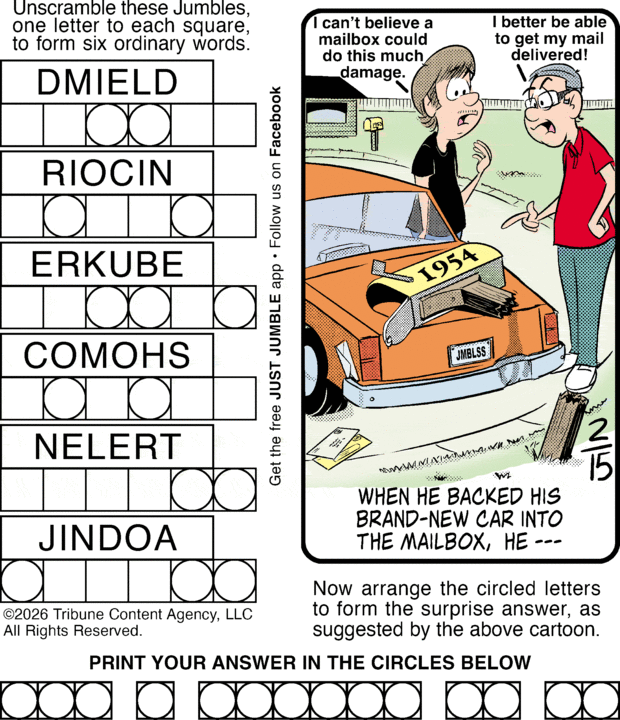
Jumble Answers for 02/15/2026


TODAY JUMBLE ANSWER

02/15/2026
DMIELD=MIDDLE
RIOCIN=IRONIC
ERKUBE=REBUKE
COMOHS=SMOOCH
NELERT=RELENT
JINDOA=ADJOIN

CARTOON CLUE:
WHEN HE BACKED HIS BRAND-NEW CAR INTO THE MAILBOX, HE —
Jumble Cartoon 02/15/2026
DDRIBUEMONTAIN
🎯 Guess the Final Answer!
01
🌟 What's Special Today
Topical hooks and real-world connections
Topical AuthoritySemantic Entities
🚗
New Car Mishap Day
February 15 marks the kind of day when brand new car owners learn hard lessons about backing up slowly and checking their mirrors carefully.
📬
Mailbox Humor Theme
This puzzle connects to classic backyard accidents. Mailboxes have been cartoon punchlines forever, especially when cars meet them unexpectedly.
📅
Historical Puzzle Date
February 15, 2026 brings us another fun day of newspaper word puzzles. Jumble fans everywhere are solving these six scrambled words together.
🎯
Six Word Pattern
Notice how today's six solved words all have between 5 and 6 letters. This medium length makes the anagram challenge just right for daily solvers.
02
📚 Word Meanings
Dictionary-quality definitions for vocabulary building
E-E-A-T: ExpertiseFeatured Snippet

👆 Tap each card to reveal the meaning

MIDDLE
Noun. The point that's halfway between two ends. If you're standing in the middle of a room, you're right in the center, not near any walls.
▼ Tap to reveal
IRONIC
Adjective. When something happens in a funny or surprising way that's the opposite of what you'd expect. It's ironic when it rains on a water park's opening day.
▼ Tap to reveal
REBUKE
Verb. To scold someone or tell them they did something wrong in a stern way. When your teacher rebukes you, you know you've made a real mistake.
▼ Tap to reveal
SMOOCH
Verb or noun. A kiss, or the act of kissing. Kids often say smooch when they think actual kiss sounds too silly or grown up.
▼ Tap to reveal
RELENT
Verb. To finally agree or give in after saying no for a while. Your parent might relent and let you stay up late if you ask nicely enough.
▼ Tap to reveal
ADJOIN
Verb. To be next to something or touch it along its edge. Two houses that adjoin share a wall or a property line between them.
▼ Tap to reveal
03
🧠 How Words Solved
Expert solving methodology step by step
E-E-A-T: Experience

👆 Tap each word to see the solving trick

DMIELDMIDDLE
Look at DMIELD and spot the D, I, E together. Rearrange around M and L to find the common word meaning the center part of something.
RIOCINIRONIC
In RIOCIN, notice the two I's. Move them around R, O, C, N and you'll uncover a word meaning surprisingly opposite or funny in an unexpected way.
ERKUBEREBUKE
Start ERKUBE with RE. Those letters go first. Then fit B, U, K, E together to make a word meaning to scold or criticize someone seriously.
COMOHSSMOOCH
COMOHS contains the word COOM hidden inside. Rearrange with S, O, H to find a kissing word that kids love to use and say out loud.
NELERTRELENT
NELERT has the ending ER. Look for the T, E, L, N to build a word meaning to finally give in after pushing back hard.
JINDOAADJOIN
Break JINDOA into J at the start. Then fit A, D, J, O, I, N to create a word meaning touching next to or sharing a border with.
04
🏗 Final Answer Built
How circled letters combine to form the solution
MIDDLE
M
I
D
D
L
E
IRONIC
I
R
O
N
I
C
REBUKE
R
E
B
U
K
E
SMOOCH
S
M
O
O
C
H
RELENT
R
E
L
E
N
T
ADJOIN
A
D
J
O
I
N
Colored letters combined →
DID A NUMBER ON IT
05
🎨 Cartoon Explained
Deep analysis of wordplay and pun structure
E-E-A-T: Expertise

Picture a guy sitting in his brand new car. He's backing up in his driveway and CRUNCH, straight into the mailbox. The mailbox gets smashed, bent, and completely wrecked.

The humor comes from the phrase "did a number on it." When you do a number on something, it means you really messed it up bad. It's like saying he ruined it. The joke plays on how you'd describe damage in a funny way instead of saying "he destroyed it."

It lands because car owners always want to protect their new vehicles, and this guy failed spectacularly within minutes. The mailbox didn't stand a chance. 8/10 for cleverness because it uses everyday slang in a punny way that makes you laugh.

06
🌎 Word Origins
Etymology and linguistic history of each solved word
Deep Authority
MIDDLE
Old English
Comes from Old English middel, meaning in the midst or center. It connected to Germanic roots showing something divided equally. Used for over 1,000 years to describe anything halfway between two points or edges.
IRONIC
Greek
From Greek eironeia, meaning feigned ignorance or pretense. Ancient Greek philosophers used irony in debates. The word traveled through Latin and French before English speakers adopted it to describe surprising contradictions.
REBUKE
Old French
Comes from Old French rebuker, meaning to check or beat back. The prefix re means again, and buke connects to striking or pushing. It arrived in English around the 1300s meaning sharp scolding.
SMOOCH
Germanic/Dutch
Possibly from Dutch smuigen or German schmuetzen, both meaning to kiss. Some scholars think it echoes the actual sound of kissing. It became popular American slang in the early 1900s and kids still love saying it.
RELENT
Latin
From Latin relentus, from re meaning again and lentus meaning soft. It literally meant to become soft again. Over time it shifted to mean backing down from a hard position or agreeing after resistance.
ADJOIN
Old French
From Old French adjoindre, combining ad meaning to and joindre meaning to join. It entered English in the 1300s describing things touching or sharing borders. Still means being right next to something today.
07
📊 Difficulty Rating
Expert assessment with detailed analysis
E-E-A-T: Authority
⭐⭐⭐ Medium

These six anagrams mix easy and tricky letter combos. MIDDLE and SMOOCH unscramble pretty fast, but IRONIC and ADJOIN will make you pause and rearrange letters several times before the words click.

The five and six letter words sit right in the sweet spot for puzzle solvers. You won't finish in 30 seconds, but you won't be stuck for 15 minutes either. Most daily players will solve these in about 3 to 5 minutes total.

6
Words
36
Letters
~2m
Avg Time
08
💡 Pro Tips
Actionable solving strategies for today's puzzle
🔤
Letter Patterns Work
Look for common letter pairs like TH, ING, ER, and ED. These combos appear in tons of English words. Spotting them inside scrambled letters saves time unscrambling anagrams.
✏️
Write Letters Down
Don't just unscramble in your head. Write each scrambled word on paper and cross off letters as you try new combinations. This prevents mix ups and helps patterns pop out faster.
🎨
Use Cartoon Hints
Read the cartoon clue carefully. It hints at the topic and tone of your final answer. Today's mailbox theme helps you think about accident related phrases and expressions.
⏱️
Start With Short Words
Solve five letter words before six letter ones. Getting quick wins builds momentum and keeps your brain warmed up for tougher puzzles later in the set.
09
❓ Frequently Asked Questions
Common queries answered with expert insight
FAQ Schema
What are the Jumble answers for February 15, 2026?

The six solved words for today are MIDDLE, IRONIC, REBUKE, SMOOCH, RELENT, and ADJOIN. Each one unscrambles from DMIELD, RIOCIN, ERKUBE, COMOHS, NELERT, and JINDOA. This Jumble puzzle was created by David L. Hoyt and Jeff Knurek.

Once you solve all six anagrams, use the circled letters from each word to unscramble the final answer. That answer solves the cartoon clue about what happened when the driver backed into the mailbox. The bonus scrambled letters DDRIBUEMONTAIN will help you complete the puzzle.

 
How does the bonus answer and final clue work?

After you solve all six regular words, certain letters get circled in each anagram. You take those circled letters and rearrange them to form a new answer. This final answer directly solves the cartoon joke clue shown at the bottom.

The bonus scrambled letters DDRIBUEMONTAIN are an anagram of your final answer. If you get stuck on the six words, you can sometimes work backwards from the bonus letters. Many Jumble solvers find that unscrambling the bonus phrase helps confirm their six word answers are correct.

 
What's the best way to solve scrambled words like DMIELD, RIOCIN, ERKUBE, COMOHS, NELERT, JINDOA?

Start by looking for common word patterns and letter combinations. Notice double letters, common endings like ER or ING, and starting blends. Write the scrambled letters on paper and physically move them around, crossing off each letter as you use it in a new arrangement.

Begin with whichever word feels easiest. Quick wins build confidence. Say possible word combinations out loud, your ears might recognize the real word faster than your eyes. If you're stuck on a word, skip it and come back later. Fresh eyes often spot the answer immediately after solving a different puzzle.

 
Where do words like IRONIC and ADJOIN come from?

IRONIC traces back to ancient Greek where eironeia meant feigned ignorance. Greek debaters used irony to trip up opponents. The word traveled through Latin and French before English speakers adopted it to describe situations with surprising, opposite meanings.

ADJOIN comes from Old French adjoindre, which combines ad meaning to and joindre meaning to join. It entered English around the 1300s. Today when two properties adjoin, they share a border. Both words show how English borrowed from other languages to build our modern vocabulary.


Similar Posts

Leave a Reply

Your email address will not be published. Required fields are marked *