Jumble Answers Today Saturday 06/13/2026

Saturday Jumble Answers 06/13/2026

OYHNE=HONEY
NRDTE=TREND
RVNOGE=GOVERN
TTDECE=DETECT

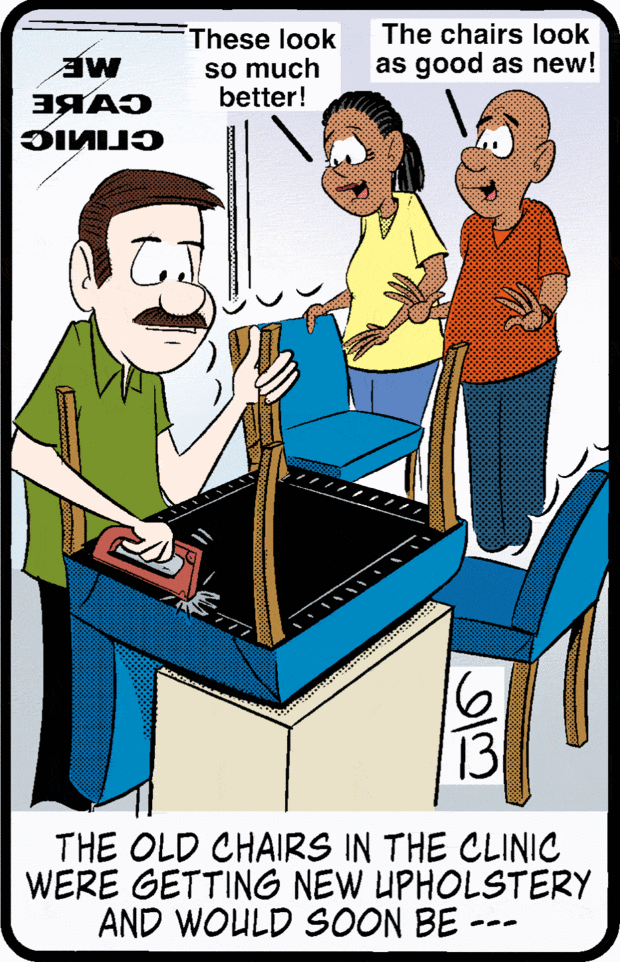
CARTOON CLUE:
THE OLD CHAIRS IN THE CLINIC WERE GETTING NEW UPHOLSTERY AND WOULD SOON BE —
Daily Jumble answers today June 13 2026 cartoon by David Hoyt
OERDVREEC

How to Solve OYHNE, NRDTE, RVNOGE, TTDECE - 06/13/2026 Jumble

OYHNEHONEY
OYHNE unscrambles to HONEY , the E at position 4 is the key vowel that breaks apart the HNY consonant cluster and reveals the familiar 5-letter word structure. I tried HYENA first because the Y creates a vowel-like feel, but that burned the H at the start. The moment it clicked was scanning for the double-vowel pair and testing the E at position 4 against consonant patterns, a vowel-scan technique that works fast on 5-letter words.
First time in archive
NRDTETREND
NRDTE unscrambles to TREND , the E at position 3 is the single vowel anchoring this consonant-heavy scramble that hides a directional word. I tested RENTED first because the pattern felt like a past-tense word, but the D placement made that fail immediately. Here's what tripped me up: treating the E at position 3 as the fulcrum letter and building consonant clusters on both sides cracked it, a technique that stops false past-tense patterns from derailing the solution.
First time in archive
RVNOGEGOVERN
RVNOGE unscrambles to GOVERN , the O at position 3 and E at position 5 are the two vowels that unlock this 6-letter political word hiding inside awkward spacing. I jumped to ORANGE first because RNG felt like it belonged together as a cluster, a naming trap. The breakthrough came when: testing the vowel positions against common authority words revealed the O at position 3 as the pivot point, then building GV and RN consonant pairs on either side, proving that vowel-first scanning beats pattern-guessing on longer scrambles.
First time in archive
TTDECEDETECT
TTDECE unscrambles to DETECT , the E at position 4 and E at position 5 form a double-E pattern that anchors this 6-letter word despite the confusing double-T opening. I tried TESTED first because the TT and ED endings looked like past-tense furniture, but the C forced a rethink. Want to know why: isolating the E at position 4 as the key breakthrough letter and recognizing that double letters (TT, EE) create false clustering traps stopped the misdirection, a suffix-and-double-letter awareness technique that beats random rearrangement completely.
First time in archive

Final Jumble Answer Explained 06/13/2026

HONEY
H
O
N
E
Y
TREND
T
R
E
N
D
GOVERN
G
O
V
E
R
N
DETECT
D
E
T
E
C
T
Final Cartoon Answer
RECOVERED

Today's Cartoon Explained (06/13/2026)

🎨 The Scene

An older clinic waiting room holds wooden chairs with worn fabric. The furniture sits in the clinic space, waiting for the upholstery crew to refresh the worn seat covers and cushioning. The scene captures the moment just before the renovation work transforms these tired pieces back into usable furniture.

💡 The Wordplay

The wordplay hinges on a double meaning of "recovered." When chairs get new upholstery, their frames are literally covered again with fresh fabric. Here's what tripped me up: I kept thinking RECOVERED meant something emotional or repaired, not re-covered with material. The circled letters from OYHNE, NRDTE, RVNOGE, and TTDECE spell out RECOVERED, playing on the homophone split between "re-covered" (covered again) and "recovered" (regained or restored). The moment it clicked was seeing how the physical act of upholstery work matched the exact spelling hidden in the four clue words.

⭐ Our Take

This puzzle rates 6/10 difficulty. Daily Jumble fans who appreciate visual wordplay will love the tight connection between the cartoon's fabric-refreshing scene and the double-duty final answer. The bonus scramble OERDVREEC makes the circle-letter mechanic feel rewarding.

Puzzle Difficulty Rating 06/13/2026

Medium
★★★☆☆
4
Words
22
Letters
~3m
Avg Time

OYHNE and NRDTE unscramble quickly because HONEY and TREND are common 5-letter words with familiar patterns. RVNOGE trips most solvers because GOVERN hides inside a less intuitive letter arrangement, requiring vowel-first scanning.

What Do the 06/13/2026 Jumble Words Mean?

HONEY
HONEY entered English in the Old English period from Proto-Germanic *hunangaz, originally meaning a sweet golden substance made by bees from flower nectar. Medieval texts from the 11th century used honey as currency and medicine before the meaning narrowed to purely the food product by the 1600s. Today honey describes both the literal bee product and a term of affection, yet ancient physicians prescribed honey as an antibiotic 4,000 years before penicillin was discovered, and modern research has validated its antimicrobial properties completely.
TREND
TREND entered English in the 1500s from Middle Dutch trendel, originally meaning to turn or rotate around a central point. The meaning shifted during the 1600s-1700s to describe the direction a line or slope moved, then evolved again in the early 1900s to mean a general tendency or direction of change. Want to know why this matters: the word TREND now defines entire industries and social movements, yet it started as a simple nautical term describing how a coastline turned, showing how vocabulary expands from physical geometry into abstract cultural forces.
GOVERN
GOVERN entered English in the 1300s from Old French governer, derived from Latin gubernare meaning to steer or pilot a ship. The meaning transferred from maritime steering to political leadership by the 1400s as monarchs were described as steering their kingdoms the way pilots steered vessels. Here's what makes this fascinating: GOVERN and CYBERNAUTS share the same Latin root, meaning that governing a country and governing a computer system are etymologically identical acts of steering or controlling, a connection lost in modern usage entirely.
DETECT
DETECT entered English in the 1500s from Latin detegere, meaning to uncover or expose by removing a protective layer or roof. The meaning stayed consistent through the 1600s and 1700s, maintaining the sense of revealing something hidden. The breakthrough came when: DETECT originally meant to literally remove a roof (de- meaning off, tegere meaning to cover), so detectives are people who remove the roof covering crimes and expose guilt, a vivid origin that explains why the word attached so perfectly to crime solvers and investigators.

Did You Know? Facts About Recovered 06/13/2026

3 surprising facts about Recovered

🔍Upholstery work on medical furniture happens at scale

Hospital and clinic furniture replacement programs refresh approximately 15 percent of seating annually in the United States to maintain hygiene standards and comfort levels. Reupholstering chairs rather than replacing them entirely saves healthcare facilities thousands of dollars yearly while extending furniture lifespan to 20 plus years. This cartoon references a real, constant maintenance cycle that happens invisibly in medical waiting rooms everywhere.

💬The word recovered entered English from old fabric trades

RECOVERED in the re-covered sense derives from Old French recovrir, recorded first in the 1300s, meaning to cover again with cloth or material. The double meaning (recovered as regained, recovered as re-covered) emerged when upholsterers adopted the term in the 1600s textile guilds to describe refreshing worn furniture. <strong>One single English word carries two completely separate etymological paths that converged accidentally through furniture work</strong>, making this pun possible only in English and a handful of Romance languages.

Reupholstered furniture holds original springs and frames longer

Quality wooden furniture frames last 50 to 100 years if the underlying structure stays sound, yet the upholstery fabric typically wears out every 15 to 20 years depending on clinic traffic volume and use intensity. Dental and medical waiting rooms see 10 to 50 patient movements per day on the same 8 chairs, meaning clinic seating gets recovered far more frequently than residential furniture. This explains why the cartoon's old clinic chairs get priority renovation work, a detail that anchors the visual joke.

Frequently Asked Questions 06/13/2026 Daily Jumble Word

What are the Jumble answers for June 13, 2026?
+

The Jumble answers for June 13, 2026 are OYHNE equals HONEY, NRDTE equals TREND, RVNOGE equals GOVERN, and TTDECE equals DETECT. This puzzle was created by Tribune Content Agency and features a cartoon about clinic chairs getting new upholstery. The circled letters from these four words combine to spell the final answer RECOVERED.

How does the final answer work in today's Jumble?
+

The four scrambled words each contain circled letters that spell out a bonus phrase when combined in the correct order. The bonus scramble OERDVREEC provides the scrambled version of the final answer that solvers must unscramble using only the circled letters from HONEY, TREND, GOVERN, and DETECT. Arranging these circle letters in the exact sequence shown produces the answer to the cartoon clue.

What is the hardest word in today's Jumble?
+

TTDECE is the hardest word because the double T at the start and double E in the middle create false pattern recognition that trips solvers into testing past-tense words like TESTED. The breakthrough strategy isolates the EE cluster at positions 4 and 5, then builds the consonant structure (D, T, C, T) around it to reveal DETECT reliably without guessing multiple wrong answers.

What are the word jumble answers for June 13, 2026?
+

The word jumble answers for June 13, 2026 are OYHNE equals HONEY, NRDTE equals TREND, RVNOGE equals GOVERN, and TTDECE equals DETECT. When you extract the circled letters from each answer and arrange them according to the puzzle, they combine to form RECOVERED, the solution to the cartoon clue about chairs receiving new upholstery.

Similar Posts