π
Cinco de Mayo Celebrated
May 5th marks Cinco de Mayo, a cultural holiday celebrating Mexican heritage and the Battle of Puebla victory in 1862.
π¨
Barbie Puzzle Theme
Today's puzzle connects to popular toy collecting and shopping decisions kids make when choosing between expensive and budget friendly options.
π
This Day in History
May 5, 1961: Alan Shepard became the first American in space aboard Freedom 7, reaching a historic milestone for space exploration.
π
Pattern Observation
Three of today's four words contain double letters, making them slightly trickier to unscramble quickly during solving.
CHORD
Noun. A combination of musical notes played together at the same time to create harmony. Guitarists and pianists use chords constantly.
▼ Tap to reveal
ELECT
Verb. To choose someone for a position by voting, like picking a president or class leader. It means the people decided together.
▼ Tap to reveal
BARREL
Noun. A large round container with curved sides used for storing liquids like oil or wine. It's wider in the middle than the ends.
▼ Tap to reveal
LOOSEN
Verb. To make something less tight or less strict. If your shoelaces are too tight, you can loosen them to be more comfortable.
▼ Tap to reveal
Look for double letters in RLRABE. Two R's stand out. Place them with A, B, E and you'll find BARREL, the storage container word.
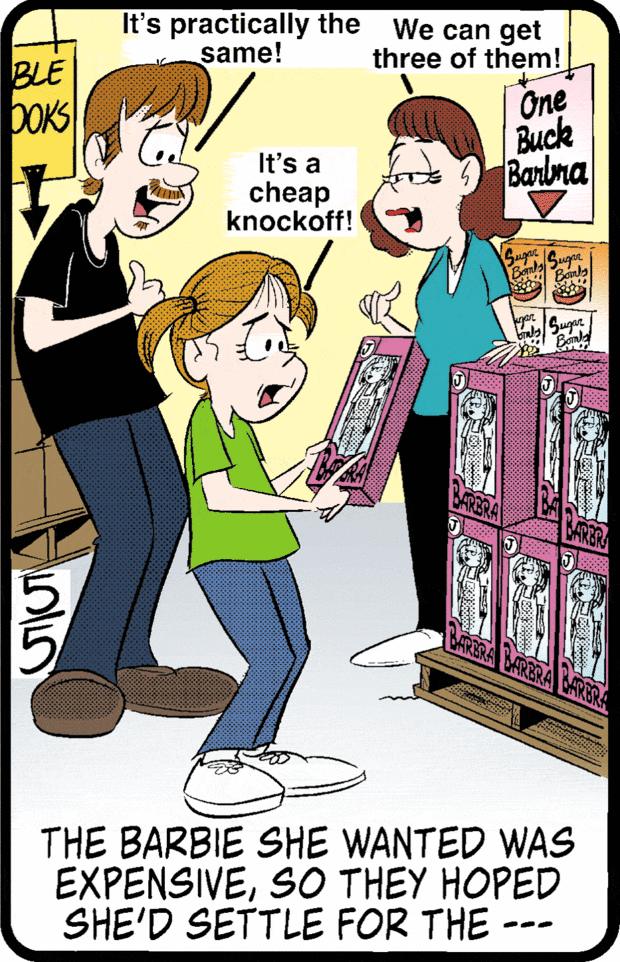
Picture a little girl holding a Barbie doll in a toy store. Her parents are looking at the expensive price tag, worried it costs way too much money. They're hoping she'll pick something cheaper instead, like a basic doll from their store's budget section.
The humor comes from the phrase 'doll her store.' It sounds like 'dollar store,' the discount shop where things cost only a dollar or two. The joke cleverly uses the word 'doll' from Barbie and 'store' to trick your ear into hearing 'dollar store.'
This pun lands really well because most kids know about dollar stores and expensive toys. It's a sneaky wordplay that parents will catch too. Rating: 8/10 for cleverness. It's punny without being too obvious.
βοΈ
Start with Vowels
Look for A, E, I, O, U first in scrambled words. They're anchors for building words. Most English words need vowels, so finding them helps everything click.
π€
Look for Patterns
Double letters like LL, RR, or OO often stay together in words. When you spot them in scrambles, keep them paired. This narrows down your unscrambling options fast.
β±οΈ
Try Out Loud
Say letter combinations aloud while unscrambling. Your ears catch real words faster than your eyes alone. This trick works great for word puzzles like Jumble.
π
Write It Down
Scribble letters in different orders on paper instead of just thinking. Seeing arrangements helps your brain recognize words you might miss mentally.
CHORD
Latin
Comes from the Latin word 'chorda' meaning string or rope. In music, chords combine strings played together. The word traveled through Old French before arriving in English around the 1300s.
ELECT
Latin
From Latin 'eligere' meaning to pick out or choose. The prefix 'e' means out and 'legere' means to choose. This voting word has been used in English since the 1400s.
BARREL
Old French
Comes from Old French 'barrel' describing a wooden container. The round shape packed tightly with metal bands kept liquids safe during storage and travel. Used in English since around 1300.
LOOSEN
Old English
Comes from 'loose' in Old English, meaning to set free or untie. The 'en' ending makes it a verb meaning to make something loose. It's been used this way for hundreds of years.
What are the Jumble answers for May 5, 2026?▼
The four solved words for today's puzzle are CHORD, ELECT, BARREL, and LOOSEN. These words were created by puzzle masters David L. Hoyt and Jeff Knurek.
Once you've solved these four anagrams, use the special circled letters to crack the final answer. The bonus scrambled word challenge uses all letters from these solved words combined together in a fresh way.
How does the bonus answer work in Jumble?▼
After solving your four main words, certain letters are circled or highlighted. These special letters rearrange to form the final answer that solves the cartoon riddle about expensive toys.
Today's bonus challenge combines all ten letters from your four solved words into one brand new phrase. It's like a second puzzle that rewards your first success. The trick is using every letter exactly once.
What's the best way to solve scrambled words like RHODC, LECTE, RLRABE, and OSNLOE?▼
Start by separating vowels from consonants in each scrambled word. Look for familiar letter patterns or combinations that could form real words. Say possibilities aloud to test if they sound right.
If one word stumps you, skip it and come back later. Your brain works better when you solve easier words first and build confidence. Most people find CHORD and ELECT fastest, then tackle BARREL and LOOSEN.
Where do these Jumble words come from historically?▼
CHORD traces back to Latin 'chorda' for string. ELECT comes from Latin 'eligere' meaning to choose. BARREL arrived through Old French 'barrel' for wooden containers. LOOSEN stems from Old English, meaning to set free.
These four words show how English borrowed from different languages over centuries. Each word tells a story about where it came from and how people used it long ago.