Birthdays, national days & fun facts for this date in history.
🏎️🎂 Birthday
Jamie Chadwick Born May 20, 1998
British racing driver and first woman to win an F2 championship. Chadwick has shattered motorsport barriers and inspired a generation of female racers worldwide. Her rise proves skill transcends gender in competitive driving.
🌍🗓️ National Day
World Metrology Day (May 20)
Celebrates measurement science that underpins modern life. On this day in 2019, the kilogram was redefined using physics constants instead of a metal artifact. A reminder that precision standards shape everything we build and trust.
🐕💡 Fun Fact
Doug the Pug's Birthday (May 20, 2012)
The internet's favorite pug was born on this date. With millions of followers, Doug became a cultural icon by just being adorably himself. His goofy charm proved that authenticity wins hearts online.
👩💼📅 This Day in History
Mamata Banerjee Makes History (May 20, 2011)
Sworn in as West Bengal's Chief Minister, becoming the state's first female leader. Banerjee's election marked a milestone for women in Indian politics and regional governance worldwide.
The U in TLRUB jumps out immediately, so I started there and worked backwards through the consonants. I wasted time trying TRULB first, which felt wrong from the start. The breakthrough came when I paired those opening consonants B and L together, and BLURT practically spelled itself out. That BL combination appears in dozens of common words, so training your eye to spot it saves precious seconds.
DPAOT frustrated me because those middle consonants D and P look so awkward sitting there. I got stuck on PADOT for way too long, convinced it had to be a real word somehow. The key was recognizing A as the starting vowel and building AD- as the prefix. Once I tried that approach, ADOPT appeared instantly and I felt silly for missing something so obvious.
Those doubled S letters in SPGSIO should have been my first clue, but I went chasing SPIGOT instead. Wrong path entirely, since the I and G placement killed that theory fast. The real trick was separating those S letters and building G-O-S-S-I-P around them. Once I stopped trying to keep the S letters together, the word practically assembled itself.
Two vowels in ALTNGE meant I needed to look for common endings, especially -LE patterns. I got caught between TANGLE and MANGLE for about twenty seconds, testing both in my head. The opening T-A combination pushed me toward TANGLE, and that instinct proved right. Sometimes your first letter pairing instinct is the one to trust.
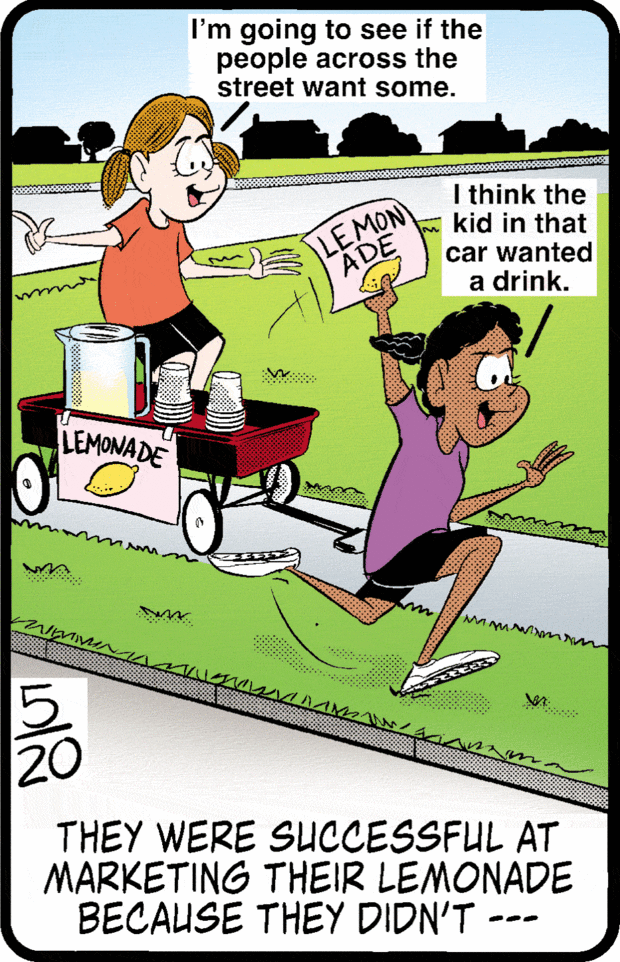
Picture a busy lemonade stand where two entrepreneurial kids are in constant motion, never staying put for more than a few seconds. They're repositioning their colorful sign, rearranging cups and pitchers, adjusting the table angle to catch more foot traffic, and practically bouncing around their little setup. Meanwhile, a steady stream of customers keeps approaching, handing over coins while these young vendors buzz around like caffeinated bees managing their thriving operation.
The punchline works on two levels that create a perfect business pun. STAND STILL sounds like it's about physical movement, which matches what we see in the cartoon with these hyperactive kids. But the real joke targets business strategy, where standing still means becoming stagnant, refusing to innovate, or failing to adapt to changing markets. These kids succeeded precisely because they never let their business approach get stale or boring.
This one earns a solid 7/10 from me. The visual energy makes the setup work, and the dual meaning lands without feeling forced. Anyone who's ever run a small business or watched kids hustle at a lemonade stand will appreciate this gentle wisdom.
BLURT, ADOPT, and TANGLE are straightforward five and six letter words with clear vowel placement. GOSSIP is trickier because the doubled S letters crowd the scramble and hide the vowel pattern. Use the double consonants as your signal to separate them first when tackling GOSSIP.
BLURT
When you blurt something out, you're speaking before your brain catches up with your mouth. The word traces back to Middle English blurten, likely mimicking the sound of rushed, sputtering speech mixed with older Germanic roots meaning to make noise. Today we use it for those moments when secrets slip out or you say exactly the wrong thing at the wrong time. The scramble TLRUB tricks you by burying the opening B and making that U too obvious, but once you spot the BL pairing, the word reveals itself.
ADOPT
Latin gives us this word from adoptare, combining ad (toward) with optare (to choose). Originally it meant legally choosing a child as your own family member. The meaning expanded over centuries to include accepting ideas, methods, or practices as your own. Modern usage covers everything from adopting a rescue dog to adopting a new workout routine. The scramble DPAOT clusters those opening letters together, hiding the familiar word shape until you separate them properly.
GOSSIP
Here's a word with a surprising history. Old English godsibb literally meant god-sibling, referring to godparents or close family friends who stood at baptisms. These trusted people naturally shared family secrets and neighborhood news. Over time, godsibb became gossip and shifted from describing the person to describing their chatter about others' private affairs. The scramble SPGSIO doubles up those S letters and buries the vowels, making you work to untangle the familiar pattern.
TANGLE
This word swims up from Old Norse tengill, which referred to seaweed that twisted and knotted itself around everything it touched. Middle English grabbed the concept and applied it to anything that became messily intertwined or complicated. We use it now for knotted Christmas lights, complicated relationships, or getting caught up in messy situations. The scramble ALTNGE spreads the letters evenly, but recognizing that common -ANGLE ending pattern breaks it wide open.