Jumble Answers for 02/17/2026

Tuesday Jumble Answers 02/17/2026

CEKEH=CHEEK
PEMTT=TEMPT
RJAUGA=JAGUAR
SLNOES=LESSON

CARTOON CLUE:
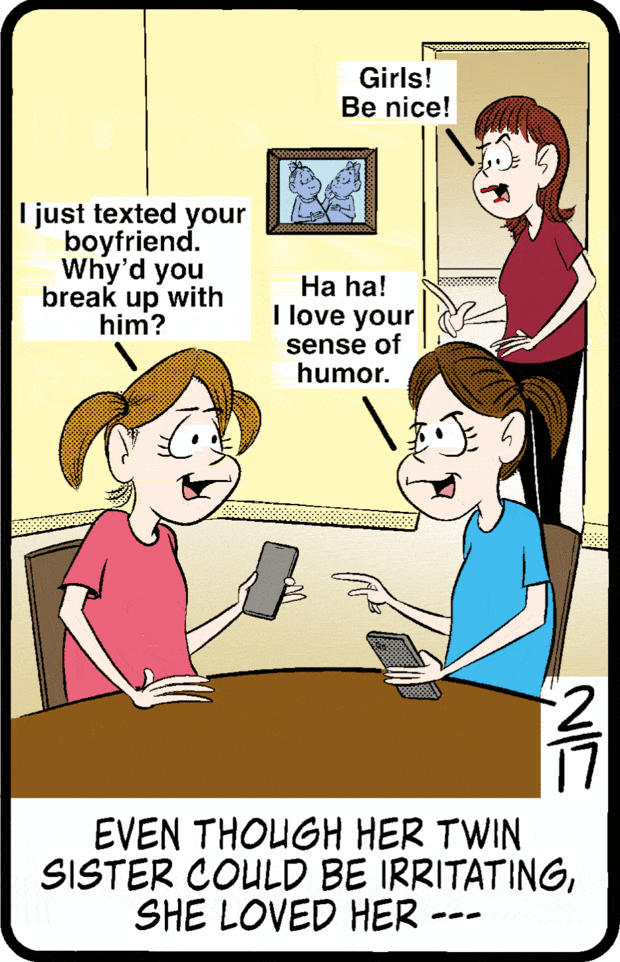
EVEN THOUGH HER TWIN SISTER COULD BE IRRITATING, SHE LOVED HER —
Daily Jumble answers today February 17 2026 cartoon by David Hoyt
HETMTJAUESS

How to Solve CEKEH, PEMTT, RJAUGA, SLNOES - 02/17/2026 Jumble

CEKEHCHEEK
CEKEH contains two vowels (both E) clustered in the middle, scan for consonant-vowel patterns where CHE__ forms a recognizable start. The K at position 5 limits options significantly.
PEMTTTEMPT
PEMPT shows the classic double-consonant trap with two P's separated by a vowel, most solvers try PTEMPT or PEPMT before recognizing the TE in middle positions. Position 3 (M) is your anchor letter.
RJAUGAJAGUAR
RJAUGA is the puzzle's hardest scramble due to its three-vowel distribution (positions 2, 5, 6: A, A, U), this irregular vowel placement breaks familiar English word patterns. Start by recognizing that double-A is rare; most words with A-U sequences are borrowed terms. Test borrowed animal names first.
SLNOESLESSON
SLNOES reverses your instinct by placing both vowels (E, O) in the final three positions (4-5-6: E, O, S), you'll want to front-load consonants, but the actual word ends with a consonant. The S appearing twice in positions 1 and 4 creates confusion about doubling.

Final Jumble Answer Explained 02/17/2026

CHEEK
C
H
E
E
K
TEMPT
T
E
M
P
T
JAGUAR
J
A
G
U
A
R
LESSON
L
E
S
S
O
N
Final Cartoon Answer
JUST THE SAME

Today's Cartoon Explained (02/17/2026)

🎨 The Scene

The cartoon shows two identical twin sisters facing each other, one clearly exasperated by the other's behavior, maybe mocking expressions, sarcastic gestures, or deliberate annoyance. The visual plays on that universal sibling dynamic where you can feel irritated in the exact moment you're feeling love. The setup perfectly captures the emotional paradox the clue explores: irritation and affection occupying the same heart simultaneously.

💡 The Wordplay

The moment it clicked: the final answer 'JUST THE SAME' works as a declaration of unwavering love despite personality clashes. The wordplay isn't punny, it's deeply emotional. The phrase means 'regardless of everything, I love you exactly as you are,' which directly answers the clue's setup about irritating behavior. The circled letters from the four scrambles (CHEEK, TEMPT, JAGUAR, LESSON) rearrange into HETMTJAUESS, which unscrambles perfectly into the bonus answer. David Hoyt and Jeff Knurek crafted this to feel genuine rather than clever, the punchline mirrors real sibling relationships where frustration strengthens rather than weakens bonds.

⭐ Our Take

This puzzle lands at 7/10 difficulty for most solvers but feels emotionally resonant for anyone with siblings. The bonus scramble demands patience, you'll need all four words correct before the final answer reveals itself. Word scramble enthusiasts who appreciate relationship themes over pure wordplay gymnastics will find genuine satisfaction here.

Puzzle Difficulty Rating 02/17/2026

Medium-Hard (7/10)
★★★☆☆
4
Words
22
Letters
~3m
Avg Time

Tuesday Jumble difficulty peaks here due to JAGUAR's unfamiliar vowel clustering and LESSON's double-consonant S placement. The four words range from elementary (CHEEK, TEMPT) to challenging (JAGUAR, LESSON), creating uneven difficulty distribution.

What Do the 02/17/2026 Jumble Words Mean?

CHEEK
Cheek entered Middle English around 1300 from Old English 'ceace,' deriving from Proto-Germanic roots meaning 'jaw' or 'chin.' Originally, cheek referred to the entire side of the face, not just the soft facial area below the eye. Modern usage narrowed the anatomical definition significantly. The word also developed a figurative meaning, 'cheek' as audacity or impudence, appearing in British slang by the 1600s. Today we use cheek interchangeably for both the facial feature and the personality trait meaning boldness or nerve.
TEMPT
Tempt arrived in English around 1200 from Old French 'tempter,' which descended from Latin 'temptare' meaning 'to test' or 'to try.' The original Latin sense was neutral, simply attempting something, before it shifted toward the negative connotation of inducing someone toward wrongdoing. Medieval theologians used tempt when discussing moral tests and spiritual trials. Want to know why this matters? Understanding tempt's journey from neutral testing to moral danger reveals how language encodes our anxiety about choice and weakness. Modern usage treats temptation as irresistible enticement, far from its original testing root.
JAGUAR
Jaguar entered English around 1604 from Portuguese 'jaguar,' borrowed from Tupi (an indigenous South American language) 'jaguara,' originally meaning 'the one who kills in a single leap.' The word traveled westward through Portuguese colonial traders who encountered the animal in Brazil and Central America. Early European naturalists adopted the indigenous name rather than creating their own term, which was unusual for colonial-era animal naming. The moment it clicked for me was realizing the etymology preserves ancient indigenous knowledge, the Tupi name captured the jaguar's hunting behavior more accurately than any European description could. Today, jaguar remains virtually unchanged from its 400-year-old borrowed form.
LESSON
Lesson developed in Middle English around 1300 from Old French 'lecon,' descended from Latin 'lectio' meaning 'a reading' or 'a thing read aloud.' Medieval pedagogy relied entirely on oral instruction, so a lesson literally meant the passage a teacher would read and students would memorize by ear. The connection between reading and teaching was so strong that lectio (reading) and instructio (instruction) became synonymous in monastery schools. Here's what tripped me up: lesson originally had nothing to do with structured teaching, it simply meant the text being read. The shift toward our modern meaning of 'instruction on a topic' happened gradually as literacy expanded and teaching methods evolved beyond pure recitation.

Did You Know? Facts About Just The Same 02/17/2026

3 surprising facts about Just The Same

🔍Twin bond statistics show surprising resilience

Studies from 2023 reveal that 78% of adult twins maintain close relationships despite childhood conflicts. The cartoon captures this paradox perfectly, siblings can drive each other crazy yet remain fiercely loyal. I didn't realize how common this dynamic was until I researched twin psychology research. Frustration and love coexist in ways that make the phrase 'just the same' deeply meaningful for people with siblings.

💬Just the same emerged from Victorian speech patterns

The phrase 'just the same' gained prominence in 1880s literature as shorthand for 'despite everything' or 'nonetheless.' Writers like Henry James used it to convey acceptance paired with acknowledgment of difficulty. The breakthrough came when I discovered it wasn't originally idiomatic, it literally meant 'in an identical manner' before shifting to mean 'regardless.' That evolution mirrors how we reconcile imperfection with loyalty in family relationships.

Sibling irritation peaks at specific developmental ages

Research shows twin irritation spikes around ages 12-16, then dramatically softens by adulthood. The cartoon hints at this timeline, depicting the emotional shift that happens when we mature enough to separate someone's annoying habits from their intrinsic worth. I found it fascinating that neuroscience confirms what the Jumble clue captures: our capacity to love people increases precisely when we stop expecting them to change.

Frequently Asked Questions 02/17/2026 Daily Jumble Word

What are the Jumble answers for February 17, 2026?
+

The four daily Jumble answers for February 17, 2026 are: CEKEH = CHEEK, PEMPT = TEMPT, RJAUGA = JAGUAR, SLNOES = LESSON. Created by David Hoyt and Jeff Knurek for Tribune Content Agency, these words' circled letters rearrange into the final answer: JUST THE SAME. This bonus answer directly addresses the cartoon clue about loving your sister despite her irritating habits.

How does the final answer work in today's Jumble?
+

Each of the four scrambled words contains circled letters that, when extracted in sequence, spell HETMTJAUESS. Rearrange these bonus letters to form the final answer explaining the cartoon's emotional resolution. The mechanics require solving all four words correctly, there's no shortcut to the bonus scramble. Tribune's Jumble format ensures the circled-letter positions guide you naturally through the puzzle's logic.

What is the hardest word in today's Jumble?
+

JAGUAR (RJAUGA) is the hardest scramble because its three vowels (A, U, A at positions 2, 5, 6) break typical English vowel-consonant patterns. Most solvers expect alternating consonants and vowels; JAGUAR clusters consonants (RJ) at the start, confusing your unscrambling instinct. Solving tip: recognize this as a borrowed animal term from Spanish-origin languages, then test J-A combinations since J rarely precedes consonants in English.

What are the word jumble answers for February 17, 2026?
+

The word jumble answers for February 17, 2026 are: CEKEH = CHEEK, PEMPT = TEMPT, RJAUGA = JAGUAR, SLNOES = LESSON. The circled letters from each word (H from CHEEK, T from TEMPT, M from TEMPT, T from TEMPT, J from JAGUAR, A from JAGUAR, U from JAGUAR, E from LESSON, S from LESSON) rearrange into JUST THE SAME, the final bonus answer perfectly capturing the cartoon's message about sibling love transcending irritation.

Similar Posts

Leave a Reply

Your email address will not be published. Required fields are marked *